

Different Types of Journaling (and How to Find What Works for You)
Journaling is sometimes thought about as if there is one right way to do it. There are many different types of journaling, but many individuals get a certain preconceived image in their head of how it should look like.
A notebook, a quiet moment, and inspiration is meant to appear…as if by magic, whilst pages upon pages of the finest prose flow freely off the top of your head.
In reality, journaling can take many different forms and look very different for each writer. What works for one individual might not feel natural for another. And what works for you in one season of life, may feel like it no longer fits in the next.
If journaling has ever felt difficult to stick with, it may not be because of a lack of discipline. It may simply be that you have not yet found a style that fits for you.
Understanding some of the different types of journaling, and their most common uses can make it easier to know where to begin – and make it easier to see what will benefit you most when life feels busier, or perhaps a little more overwhelming.
There is no single “correct” way to journal
Before exploring the different types, it helps to let go of the notion that journaling is meant to look a certain way.
It doesn’t need to be completed daily, look neat, be deeply insightful, or be perfectly structured.
Some days it may feel clear and focused. And on others, it may feel scattered or repetitive.
Try not to panic, it’s completely normal – both are a part of the journaling process.
Journaling works best when it meets you where you are, rather than asking you to become someone more organised, more reflective, or more consistent than you feel.
Free writing (stream of consciousness)
This is one of the simplest and most accessible ways to journal, so it’s a good form to start with – it’s very loose and unrestrained, which many individuals find liberating.
You begin writing whatever comes to mind, without editing or structuring your thoughts.
There is no need to make sense. In fact, the writing often becomes more useful when it does not.
Free writing can help when:
- your mind feels busy
- you are overthinking
- you do not know where to start
Sometimes, simply getting thoughts out of your head and onto the page can help to create a sense of space.
If you often feel mentally stuck, this approach can be especially helpful. You can explore this method more deeply in journaling for overthinking.

Prompted journaling
Prompted journaling offers a gentle starting point when a blank page feels overwhelming.
Instead of deciding what to write, you respond to a simple question or idea.
Prompts can guide your thinking without restricting it.
If you’re not sure where to begin, you can find prompts on in our journaling section here.
Reflective journaling
Reflective journaling focuses on understanding your thoughts and experiences more deeply.
Rather than simply describing your day, you explore how things felt and why they may have affected you.
Over time, this can help you notice patterns and help you respond to situations more intentionally.
Reflective journaling can be especially useful when you are trying to make sense of your thoughts or decisions.
Emotional journaling
Sometimes journaling becomes a place to release what feels difficult to carry.
Emotional journaling is less about structure and more about honesty.
The goal is not to fix any feelings immediately, but to allow it to be expressed.
For many people, this can bring a sense of relief and clarity, even if nothing is fully resolved.
If this resonates, you might like to read more about emotional journaling on journaling for anxiety.
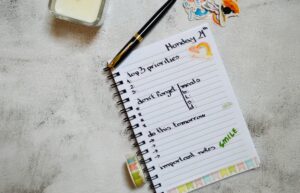
Planning and intention journaling
Journaling does not always need to look inward. It can also help you move forward.
Planning or intention-based journaling focuses on:
– setting priorities
– clarifying what matters
– creating gentle structure for your day or week
This approach works well alongside simple routines and can help reduce the feeling of being scattered.
Gratitude journaling (a gentle shift in focus)
Gratitude journaling is often seen as a separate practice, but it can be woven into other types of journaling.
Rather than forcing positivity, it simply invites you to notice small things that felt steady or supportive.
Over time, this can help balance your perspective without ignoring difficult feelings.

Other journaling styles you might like to explore
There are also many more creative and structured approaches to journaling that may suit you, depending on what you enjoy – this article has mainly focused on the main purpose based journaling styles, but other formats can definitely be used to explore and reflect in a different way.
Some other ways to explore journaling include bullet journaling – a way to organize tasks and track habits visually. Scrapbook or art journaling is also very popular – where the focus is less on writing and more on creativity, images, and expression.
You may also find that using an image as a prompt or visual starting point can help you access thoughts that may feel harder to put into words.
These approaches can be just as meaningful, especially if you find traditional writing less natural.

Finding what works for you
You don’t need to choose one type, and stick with it forever.
Some days you may need free writing. Other days, a single prompt may be enough. At times, journaling may feel reflective. At other times, it may feel practical.
Personally, I’ve found that journaling works best when it feels flexible. Trying to follow a rigid method often makes it harder to return to.
Instead, it can help to ask – What do I need from this page today?
That question is often enough to guide you.
Journaling is not something to get right. And it should be something to return to.
If a particular style does not feel helpful, you are allowed to change it. If you miss a few days, you can begin again.
The value is not in doing it perfectly, but in having a place to come back to, when you need it.
There are many different types of journaling, but they all serve the same purpose, in their own way.
They create space.
Space to think, to feel, to process, and sometimes simply to pause.
If you aren’t sure where to begin, try starting with what feels most natural today.
As always, feel free to take what resonates, leave the rest, and let your journaling practice evolve over time.
Good luck on your journaling journey!

Pingback: Journaling for Anxiety: How to Calm Your Mind on Paper - The Reset Journal
Pingback: Journaling for Decision Making - The Reset Journal