

How to Use Journaling for Decision Making (A Clear Framework)
Some decisions don’t feel straightforward. You may go back and forth between options, overthink possible outcomes, or feel unsure what you actually want. The more you think about it, the less clear it can become. If you feel like this at any point, why not try journaling for decision making.
Part of the problem is that thinking happens internally. Your thoughts stay mixed together, and it’s easy to feel like you understand them more clearly than you actually do.
Something changes when you write things down.
Research into expressive writing suggests that putting thoughts into words can help organize them, and make them easier to process. What feels clear in your head can look very different once it is written out. This study concluded that journaling is an effective strategy for enhancing thinking skills.
Why decisions often feel unclear
Before you begin, it helps to understand why decisions can feel difficult in the first place.
Often, it’s not a lack of information.
It’s often because:
- Your thoughts are happening all at once
- Emotions and logic are mixed together
- You are imagining outcomes without defining them
- You are trying to hold too many variables in your head
This can create the feeling of “thinking in circles,” where nothing moves forward.
Writing down your thoughts interrupts that loop.
Why structure helps when making decisions
Free writing can be helpful, but without direction, it can also keep you circling the same thoughts.
A more structured approach works a little differently.
It helps you to:
- Separate your options clearly
- See what you are assuming
- Notice what you are avoiding
- Slow your thinking down
- Make your reasoning visible
Instead of trying to think your way through a decision in your head, you begin to see it laid out in front of you clearly.

How to use journaling for decision making
Take a blank page and move through these steps slowly. You don’t need to rush or complete everything perfectly.
Step 1: Define the decision clearly
Write the decision in one simple sentence.
Be specific.
Clarity here helps to make the next steps easier.
Step 2: Capture your current thinking
Before analysing anything, write down what you already believe.
- What do you think will happen?
- Why do you think that?
- How confident do you feel?
This creates a snapshot of your thinking, before it changes.
Step 3: Lay out your options in more detail
Write each option separately.
For each option, write:
- what it would involve
- what might change
- what feels appealing
- what feels uncertain
Step 4: Explore possible outcomes
For each option write:
- best case
- most likely case
- worst case
This step helps you move beyond assumptions, and consider the fuller picture.
Often, you may find that your “worst case” is less extreme than it feels.
Step 5: Notice your reactions
Now pause and read what you’ve written.
Ask yourself:
- Which option feels lighter?
- Which one feels heavier?
- Is there one I’m trying to convince myself of?
This step helps you see where your thinking may not be fully objective.
Step 6: Identify what matters most
Instead of trying to weigh everything equally, ask:
What matters most in this decision?
Depending on your priorities, this could be:
- stability
- growth
- time
- flexibility
- calm
Now look back at your options, and notice which aligns most closely.
Step 7: Choose a next step
You don’t need to make a final decision immediately.
Instead, choose a small next step.
This might be:
- gathering more information
- testing one option
- having a conversation
- setting a time to decide
This helps you move forward without pressure.
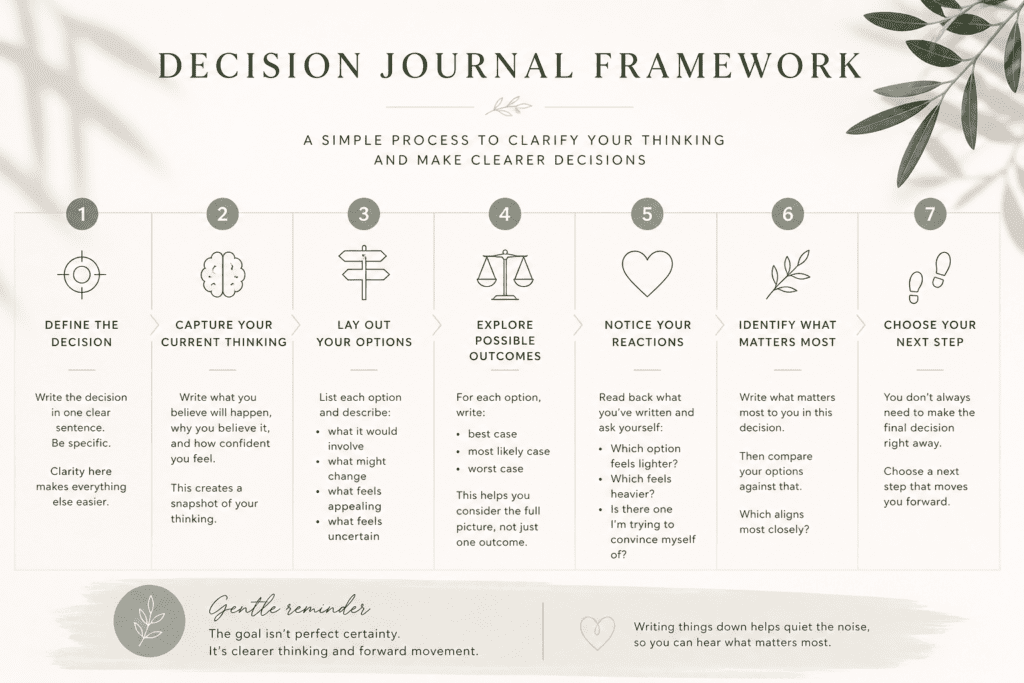
If you prefer to see the structure visually, you can follow this simple framework summary:
A simple example
If you feel unsure how to apply these steps to decision making, here’s an example of how this can look in practice.
Decision:
Should I commit to a new routine, or should I keep things flexible?
Options:
- Structured routine
- Flexible approach
What stands out:
- Routine feels calming, but also restrictive
- Flexibility feels easier but is less focused
What matters most:
- feeling calm and consistent
Next step:
- try a light structure for one week
Common mistakes to avoid
When using journaling for decision making, it’s easy to fall into a few patterns:
- writing without direction, and staying stuck
- trying to force a final answer too quickly
- focusing only on logic and ignoring how you feel
- expecting complete certainty
The goal is not to eliminate uncertainty, but to understand it more clearly.
Why this works
This approach can be helpful when making decisions, because it makes your thinking visible.
Instead of relying on memory or instinct alone, you create a record of what you believed, and why.
Over time, this helps you:
- Recognise patterns in your thinking
- Feel more confident in your choices
- Make more consistent decisions
You don’t need perfect clarity to move forward.
Often, you just need to slow your thinking down enough to see it properly.
If you feel stuck, try working through this structure, and see what becomes clearer for you.
As always, you are welcome to take what resonates, leave the rest, and allow the process to guide you to your answers.
If you would like to explore other types of journaling, you can read about some common styles here.