
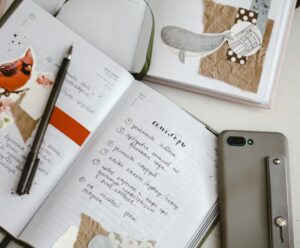
How to Start Art Journaling : When You Can’t Find the Words
If you’re not sure how to start art journaling, or how it could help you, this article has you covered.
There are times when putting your thoughts and emotions into words feels impossible.
You might feel overwhelmed, disconnected, or unsure what you’re even trying to express.
You sit down to journal, but nothing comes out clearly. Times like these are a perfect time to give art journaling a try.
Instead of trying to explain everything using words, you allow yourself to explore what you’re feeling visually. There is no pressure to make sense of it straight away, and having no expectation to find the right words to describe it can be particularly helpful if you feel overwhelmed or confused by your emotions.
Why Art Journaling Can Help, When Words Feel Out Of Reach
When your thoughts feel tangled or unclear, writing can sometimes make that feeling more obvious.
When you start art journaling, you quickly discover it works differently.
It gives you a way to:
– Express emotion without needing to define it
– Release mental pressure without overthinking
– Notice what you feel, rather than explain it
Research into using art as a means of emotion processing suggests it is an effective method, and that emotional processing is associated with improved physical and psychological health.
With art journaling, the act of processing your emotions becomes more flexible.
You are not trying to organize your thoughts. You are allowing them to take shape in a different way.
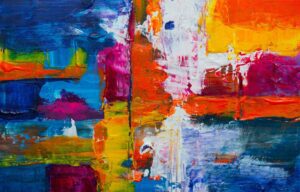
What Art Journaling Actually Looks Like
Art journaling does not need to be complicated or artistic.
There is no ‘right’ outcome.
Some ways you might like to explore thoughts and feelings through art are by:
– Using colour to reflect how you feel
– Drawing shapes or patterns
– Layering textures or marks
– Adding small pieces of text, if you’d like to
Pieces may feel messy, unfinished, or unclear. That is normal, and part of the process.
You are not creating something to show. You are creating something to explore.
How To Begin (Without Overthinking It)
If you feel like you really don’t know how to start art journaling, keep it simple.
Follow this guide to get started on your first piece.
Choose one small entry point, and see where it takes you.
Choose a Medium
There are so many options here if can be a little overwhelming. Of course, if you have a preference – by all means, start with that.
If you are new to creating art, you might find the following few suggestions the most easily available to you:
– Coloured pencils
– Coloured pens
– Poster paint
– mixed media collage
You don’t need to have specialist equipment, paper, or canvas – ordinary paper and pencils is a perfect place to start – or if you’d prefer to create collage style art, you could try ripping or cutting various shapes from recycling such as old magazines, recycled cardboard and string with pva glue to create different textured art pieces.
Start With A Colour
Try picking a colour that feels closest to your current mood.
You don’t need to justify it – just choose the one that resonates with you at this moment.
Fill part of your paper / art canvas with it – lightly, heavily, or somewhere in between, whichever feels right.
Try to notice how it feels as you use it.
Let Your Hand Move Freely
Instead of trying to draw or cut something specific, allow your hand to move freely without too much judgement.
It doesn’t matter if you create straight lines, abstract shapes, or repeated patterns – the goal is not to create something recognisable, but to create movement.
Add Layers Gradually
If you feel like continuing, try adding another layer.
You might like to introduce a second colour, or draw or layer over existing marks.
Let the page build slowly, without trying to control the outcome.
Pause and Notice
After a few minutes, take a step back.
Look at the page and ask yourself:
‘Has this process raised any new thoughts or feelings?’
You don’t need a clear answer.
Just noticing any changes is enough.
A Different Way To Approach Your Thoughts
Art journaling is not about avoiding your thoughts.
It is about approaching them from a different angle.
Sometimes, trying to explain everything with words can keep you feeling stuck.
By stepping away from words, you may begin to understand what you’re feeling in a quieter, less direct way.
Over time, you may find you would like to move on to written journaling. You might enjoy exploring Journaling for Clarity.
When To Use Art Journaling
This approach can be helpful when:
- your thoughts feel too overwhelming or confusing to write down
- you feel disconnected from how you’re feeling
- you want a gentler way to process your emotions
Art journaling doesn’t need to replace writing. It can simply be another option to explore.
Letting Go Of Doing It “Right”
It’s easy to feel like you need to be creative or artistic to try something like this.
But you don’t.
Art journaling is not about skill. It is about giving yourself permission.
Permission to:
– Make something imperfect
– Express something unclear
– Explore, without needing an outcome
The page does not need to make sense to anyone else.
When you can’t find the words, it doesn’t mean you have nothing to say.
It may just mean you need a different way to begin.
Art journaling offers a quieter, more open way to explore what’s there, without pressure or expectation.