
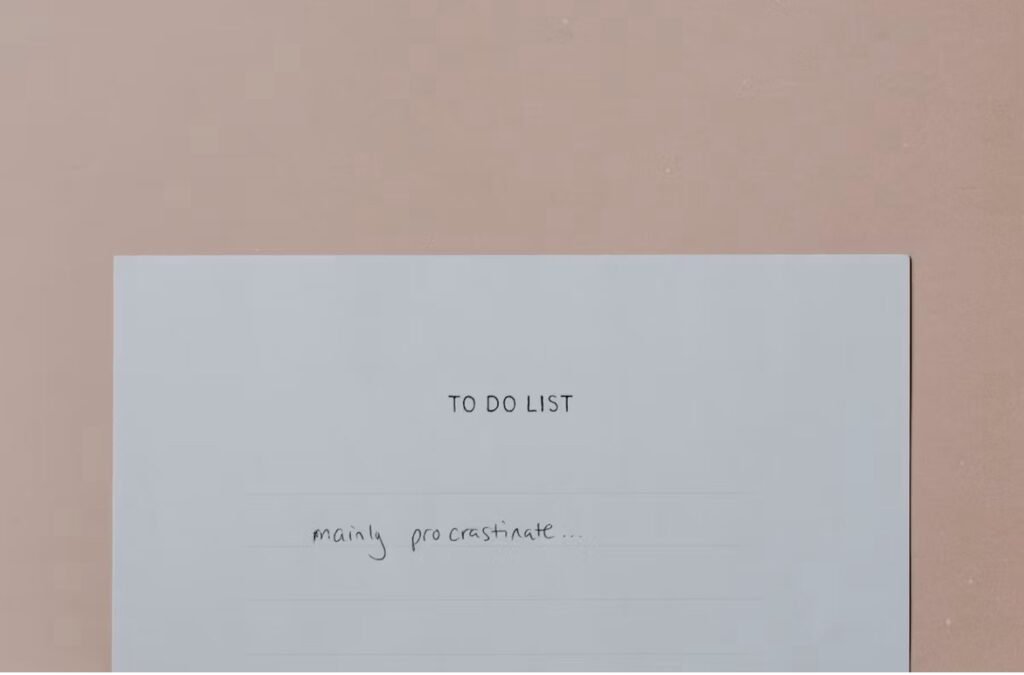
Why Am I Procrastinating? (It’s Probably Not Laziness)
Have you ever found yourself putting off something that you know would only take ten minutes, and get frustrated with your inability to complete the task? You know you need to do the thing… you want to do the thing.. but you just don’t understand why you can’t seem to just do it. If you can relate to this, you have probably asked yourself many times, ‘why am I procrastinating?’
It can happen with many different seemingly simple day to day tasks. Like replying to an email, booking a dentist appointment, returning a parcel, or even folding that pile of clean washing that’s been sitting on the chair for three days.
Logically, you know these aren’t particularly difficult tasks. Yet somehow they continue following you around in the back of your mind, quietly taking up more and more mental space with every passing day they’re left unfinished.
I’ve definitely found myself doing this throughout my life. I once spent almost a week avoiding making a simple phone call to rearrange an appointment. Every day I’d think, “I’ll just do that later.” The phone call itself took less than four minutes. The mental energy I’d spent thinking about it all week was far greater than the task ever deserved.
For a long time, I believed that procrastination meant I was lazy or unmotivated – because that’s what many people assumed as I was growing up. I would be angry at myself as I would think ‘I don’t understand! Why am I procrastinating?’
Nowadays, I think it’s more recognized that procrastination is usually caused by something else entirely.
More often than not, procrastination is the brain’s way of avoiding discomfort, uncertainty or mental overload rather than the task itself.
Understanding why you’re procrastinating is often far more helpful than simply telling yourself to “try harder”.
Procrastination Isn’t Always About Motivation
We tend to imagine procrastination as choosing to do something fun, instead of something important.
Sometimes that’s true… but most often it’s much more subtle.
Some of the most common reasons people procrastinate can be:
– They don’t know where to begin
– The task feels bigger than it really is
– They’re worried about getting it wrong
– They are already mentally overloaded
– Exhaustion
- Or maybe there are simply too many competing priorities
Psychologists describe procrastination as a form of self-regulation failure, but research also shows it is closely linked to emotional regulation. In other words, we often avoid the feelings a task creates, rather than the task itself. If something feels stressful, uncertain or emotionally uncomfortable, our brain naturally looks for something easier or more rewarding to do instead.
That’s why you might suddenly feel the urge to reorganize a cupboard, instead of sending an awkward email.
It’s not that the cupboard is more important.
It simply feels emotionally easier.
The Hidden Cost Of Putting Things Off
Ironically, procrastination rarely gives us the relief we’re looking for.
Instead, unfinished tasks tend to linger in the background of our minds.
Psychologists have long recognized what’s known as the Zeigarnik Effect. This is our tendency to remember unfinished tasks more vividly than completed ones. This can often explain why the things we’ve been avoiding often pop back into our thoughts at inconvenient moments, creating a constant sense of low-level mental clutter.
The longer we avoid them, the heavier they can begin to feel.
Sometimes, the task itself stays exactly the same. Only our perception of it changes.
Some Tasks Aren’t Difficult – They’re Just Unclear
One thing I’ve noticed, is that I’m much less likely to procrastinate over tasks that have an obvious first step.
I most often procrastinate when a task feels vague.
For example, “sort out all of my clothing” sounds enormous.
“Sort one drawer of clothes” feels easier and less overwhelming, with a definite start point.
Our brains generally cope better with clarity than ambiguity.
If you’re stuck, ask yourself:
What Is The Very First Visible Action?
Not the whole project – try to identify just the first thing that you can actually do, even if it’s only a small thing – often, that’s can give you the momentum you need to actually start the task.
When Procrastination Is Linked To Overwhelm
Sometimes, procrastination has very little to do with the task itself. It often happens because your brain is already carrying too much.
If you’re trying to remember dozens of jobs, decisions, appointments and responsibilities at the same time, even a small additional task can feel like one thing too many.
This is where I find a quick brain dump, or a quick reset far more helpful than trying to just force myself to “be productive”.
Reducing mental load often makes action feel easier naturally.
A Note About ADHD
Although everyone procrastinates occasionally, it can be a particularly common issue for people with ADHD.
Difficulties with executive functioning, such as planning, prioritizing, starting tasks, or even just estimating time – can make seemingly simple jobs feel disproportionately difficult.
That doesn’t mean every instance of procrastination is ADHD, nor does it mean that everyone with ADHD experiences it in the same way. But recognizing that there are many different reasons behind procrastination can help us respond with an open mind to help identify the cause, rather than leaping immediately to self-criticism.
Whether your procrastination is linked to ADHD, perfectionism, stress, or simply having too much on your plate, understanding the underlying cause is infinitely more helpful than just labelling yourself as lazy.
A Simple 5-minute Reset When You’re Stuck
If you’ve been avoiding something for days, you might like to try this quick reset, to help you get started.
Take five minutes, and answer these questions:
1. What exactly am I avoiding?
Name the specific task that you have been putting off.
2. Why does this task feel difficult?
Perhaps the task feels unclear? Or boring? Emotionally uncomfortable? Or just feels too big and you don’t know where to start?
3. What is the smallest first step?
Not “the whole task”, just the first little step to start it. If it’s making an appointment, that could be checking your diary for availability, or finding the number you need to call, for example.
4. Can I spend five minutes on it?
Give yourself permission to stop after five minutes, even if you haven’t completed a significant amount of the task. Often getting started is the hardest part, and once you have started it, you may feel like the rest is more achievable.
5. What can wait?
Sometimes procrastination is a sign that you’ve simply committed to too much. Remember that not everything needs doing today. When you’re feeling overwhelmed, it’s ok to put off tasks that can wait a day or two.
Be Kinder To Yourself
I don’t think most people procrastinate because they’re lazy.
Usually, it’s because they are overwhelmed, mentally overloaded, uncertain where to begin, or trying to avoid an uncomfortable feeling, without even realizing it.
The next time you catch yourself putting something off, try asking yourself a different question.
Instead of being cross with yourself, saying to yourself “Why am I procrastinating? Why can’t I just get on with it?”
Try asking yourself: “What is making this task feel so difficult?”
The answer may tell you far more than the task itself ever could.
The most helpful approach to procrastination isn’t just trying to push harder, and being negative to yourself whenever you fail.
It’s making the first step feel possible.